
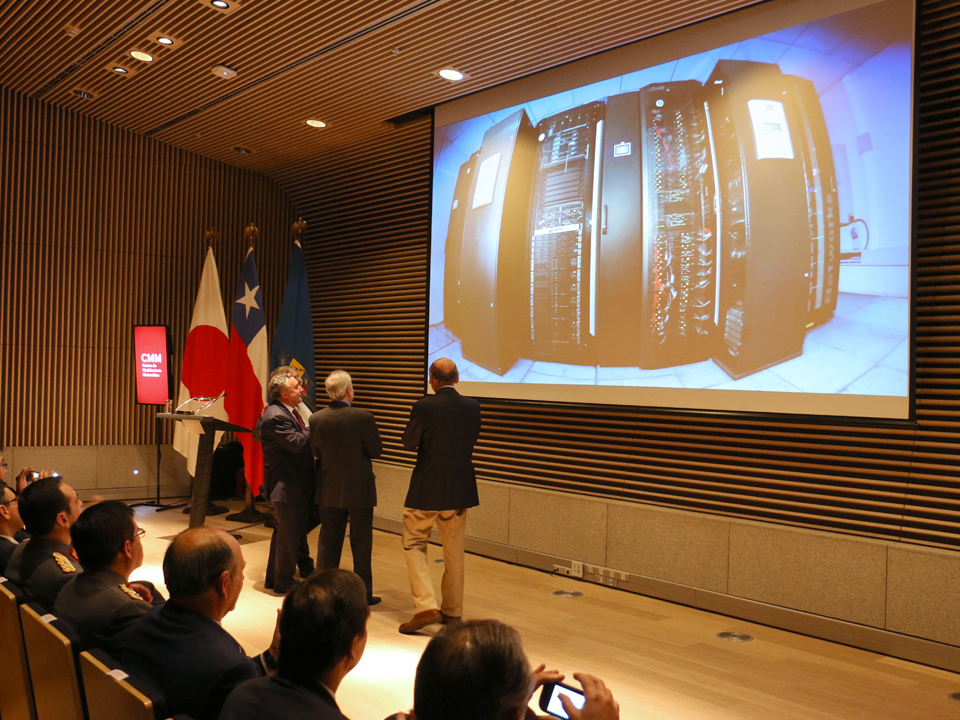
On May 6th was the official start up ceremony of Letraru, the fastest Chilean supercomputer of the National Laboratory of High Performance Computing (NLHPC), at the Center for Mathematical Modeling (CMM) of Universidad de Chile . Its high processing capacity will be available for the science, the state and companies in areas such as mining, energy, sustainability, environment, biomedicine, among others.
The event was chaired by the President of the University Ennio Vivaldi and was attended by President of Conicyt Francisco Brieva, CMM’s director Alejandro Jofré, NLHPC’s executive director Eduardo Vera, the chairman and scientific director of the laboratory Jaime San Martín.
Vivaldi said that this infrastructure will articulate a cooperatively work. “What FCFM and CMM has carried out it is enrolled in the best history and tradition of Universidad de Chile. What we are doing is a substantial contribution to the Chilean State, the nation, the Republic and this is what defines to the University since its inception,” said Rector, who noted that this project will provide the first impetus to the photonic network, which will connect the entire territory via fiber optics.
Following that idea, Jofré noted that this supercomputer has a positive impact on various areas of national life. Not only in science or economy, but also in public politics. He cited the reaction time in case of earthquakes, tsunamis, volcanic eruptions and other events as an important issue in the country: “This supercomputer connected to a national network and photonic sensors allow finally create an early warning system throughout Chile”.
Brieva remembered he was the Dean of the Faculty of Physical and Mathematical Sciences when the project applied to the Conicyt’s Programa de Investigación Asociativa and highlighted he was opening it now as president of this State’s agency.
In that sense, San Martin, chairman and scientific director of NLHPC, acknowledged the project collaborators and remembered the ideas that inspired the foundation of this laboratory:“Leftraru is founded on three principles that are very hard to find in Chile: cooperation based on merit, equity and free access.”
“These facilities allows the modeling of high complexity problems with processing and management of Big Data in real time, which has a significant impact in the optimization of industrial processes and the dynamic assestment of the risks,” pointed out Vera, NLHPC director.
The new cluster of the National Laboratory of High Performance Computing (NLHPC) has a processing capacity of 50 teraflops, equivalent to 25,000 notebooks working at the same time. These features placed it as the second most powerful supercomputer of Latin America in the Lartop 50 ranking, created by HPC Initiative Latam and maintained by Universidad de San Luis (Argentina)
This new equipment can perform experiments, compute data and make simulations in areas such as genomic sequencing, drug design, creating new materials, nanotechnology, astronomy, aeronautics design, use of software for optimization, fleet scheduling, medicine, molecular dynamics, city traffic management, security, education and supply chain network health, for example.
The access to this equipment is fully free for universities, research centers and scientists whose projects require high computing power. Thus, the number of partner institutions has grown from the eight that originally applied the project at Conicyt to 17 along Chile. In addition, the 15% of the Leftraru’s computing capacity must be available to the industrial and productive sector.
The super-machine is funded by the Conicyt’s Programa de Investigación Asociativa and is located in the datacenter of the Faculty of Physical and Mathematical Sciences of the University of Chile.
Partners NLHPC
Universidad de Chile, Pontificia Universidad Católica de Chile, Universidad de Santiago, Universidad Católica del Norte, Universidad Técnica Federico Santa María, Universidad de la Frontera, Universidad de La Serena, Universidad de Talca, Universidad de Antofagasta, Universidad Austral, Universidad de Concepción, Universidad del Bío-Bío, AURA Observatory Chile, Inria-Chile, Centro Interdisciplinario de Neurociencia de Valparaíso, Fundación Ciencia y Vida and REUNA.
[alpine-phototile-for-flickr src=”set” uid=”89937484@N08″ sid=”72157653903096971″ imgl=”fancybox” size=”240″ style=”floor” row=”4″ num=”12″ align=”center” max=”100″ nocredit=”1″]