
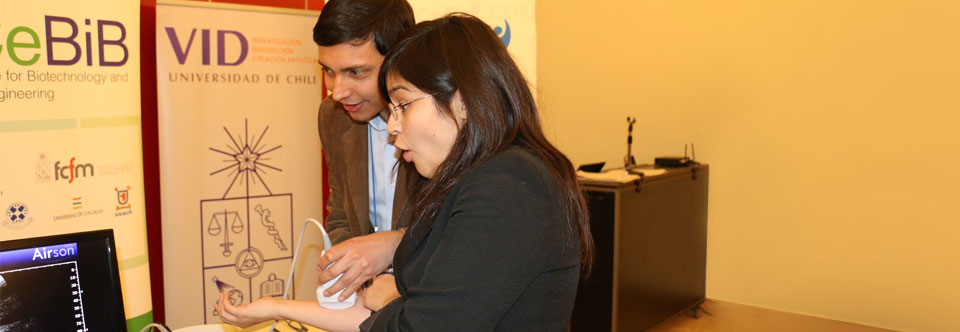
Taote, the low cost, 800 grams weight portable ultrasound headed Corfo´s Innova program Go to Market 2015, whose aim is to expand Research and Development (R&D) technology developed in the country towards global markets. Thus, the device that was created in 2013 by Carlos Conca, researcher at the Center for Mathematical Modeling (CMM) of the Faculty of Physical and Mathematical Sciences (FCFM) -Universidad de Chile, and his team becomes the first project of this entity that has made it to this third phase of the competition and also to travel to Silicon Valley (USA).
“This part is complicated. One arrives to a free ocean, where hundreds of businesses are made by the minute. I can not even figure it out. It makes me think of a parallel universe”, said Conca, who is also a researcher at the Center for Biotechnology and Bioengineering (CeBiB), also part of the FCFM.
The ultrasound scanner, also known as Taote, already has its boarding pass to Silicon Valley. Next 6th July discussions with potential clients, the media, influential people, entrepreneurs and investors based on the mecca of the global technological entrepreneurship will start.
Doctor John MacKinnon, who created with Conca the ultrasound scanner, along with engineers Rodrigo Maureira and Vader Johson, in charge of the technical and managemental part respectively, will go on board for the USA with the ultrasound scanner in the luggage to finally face this last phase of the Go to Market program.

MacKinnon explains that some contacts have been already made, but he prefers not to reveal names, as at the moment the meeting agenda is being scheduled. “We have an unique opportunity that opens broad possibilities, as it will connect us with important people in the field”, he highlights.
The main challenge will be to find a specific niche in the market where the ultrasound scanner would work well from a commercial and a technological point of view.
The contest will finance the living costs of the winners in San Francisco for a month.. However, correspondences have already started. Johnson travelled in April to New York and Chicago, where he exposed at the el International Symposium of Biomedical Imaging (organized by Siemens and Columbia University), and met brokers and medical professionals. With the information collected there, the team is preparing and defining more accurately the roadmap.
Back from Silicon Valley, the experience will allow to gather the necessary knowledge to embrace success. “The purpose of going there is to rise capital here”, says Johnson.
A high -performance contest
At the Development Corporation of Production (Corfo, because of its acronym in Spanish) on 29th May 2015, the portable ultrasound was presented. Attendees also listened to Dennis Tsu, director of the Stanford Research Institute (SRI), institution that was founded by the University of Standford in 1046 and pioneer in entrepreneurship. One of its milestones was, for instance, the development of the first computer mouse. Tsu expressed that Chile has excellent ideas and people, but that in order to have a strong technology transfer, the country will have to face important challenges such as to increase investment in R&D and support to the Trasfer and Technology Offices (OTL).

As it was shown during the presentation, nobody said that making it to Silicon Valleywas an easy task. In fact, the ultrasound scanner had to overcome demanding tests towards other 16 projects. Over five months, the creators of the ultrasound scanner attended two training workshops; afterwards they had to expose their initiative.
“We selected the portable ultrasound scanner considering the positive development that showed during the training, as well as the clear understanding about the investment required to introduce the portable ultrasound in the market”, stresses Marcelo González, coordinator at OTL Corfo.
The contest comprised three phases. After coming out of the first two, which were focused on the training, the six selected projects have now entered the third and last phase. They will immerse themselves in an international ecosystem that hosts the avant-garde of entrepreneurship. Their mission will be to either make grow the team or to do market research. They will count with support from the SRI institution that was founded by the University of Standford in 1046 and pioneer in entrepreneurship. One of its milestones was, for instance, the development of the first computer mouse.
In previous editions, other projects by Universidad de Chile passed the first two phases of the contest, but never stepped in Silicon Valley.
Commercial licenses
The ultrasound scanner has mutated from its origins into different skins. Initially, it was a Corfo`s Innova project created by John MacKinnon and Carlos Conca, which was afterwards joined by professors Manuel Duarte and Nicolás Beltrán (1947-2014).
The patent rights of this prototype were owned until last 16th May by John MacKinnon y Asociados Ltda., Megasalud and Universidad de Chile. Nevertheless, they were not interested on its commercialization. They were either orientated to offer health services, as it is the case with the first two, or they were not authorized due to their legal structure, as it is the case with the last one. Thus, they created a start-up, Medical Innovation, whose unique investor is John MacKinnon, to whom the rights were assigned for a period of 4 years.
“Transferring the patent of the portable ultrasound opens big opportunities for technology at a global stage”, points out Varinka Farren, Director of Universidad de Chile`s Business Unity for the Innovation Entity. This means a landmark to the transmission of knowledge generated in the University onto the society, which is the third mission of Universidad de Chile and with which there´s a strong commitment.. This unity has Indeed, licensed technologies since it was founded in 2013.
However, there are still technical aspects to improve so that the future commercialization can be as successful as possible. As for example, incorporating the Doppler effect (capturing objects in movement), as well as the wireless transmission from the device into the glasses or the screen.
