
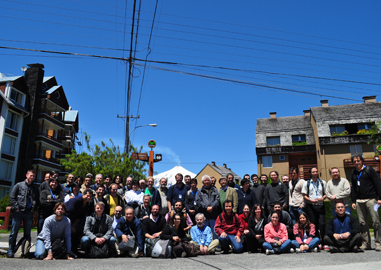
Professor Servet Martínez, a member of the Organizing Committee of the “VI School of Information and Randomness” referred to the new format introduced this year to the event, made for the first time outside of Santiago, to convene a panel of experts in the area and invite motivated students focused on scientific themes.
This school now has its sixth version, 10 years of existence to be an event that brings together specialists in the area every 2 years.
On this occasion, in an original way, was made by invitation, being only graduate students and its areas congregated.
Professor Martínez said that the invitation and participations was excellent at both national and foreign, and stressed that all participant attended all given presentations during the 4 days of the school, which in his opinion this proves ” The School has grown in quality, the students who attend are highly motivated on the border of knowledge and are able to give talks at a good level.”
To conclude, it was achieved the goal of making a school to create a favourable environment in which it is discuss the latest developments in the area.
As usual, after such international meetings, many foreign researchers are spending a few days in the CMM to exchange points of view about certain topic or to refine details in publication co-authored by Associated Research of the CMM. On this occasion, we were invited by the experts in this area: Terry Lyons (Oxford University); Renming Song (Illinois at Urbana-Champaing University), Edgardo Ugalde (Universidad Autónoma de San Luis de Potosi), Xavier Bressaud (Tolouse University), Mike Boyle (Maryland University) and Pierre Collet (CNRS-Ecole Polytechnique).
The foreign expert opinion
Mike Boyle, one of the foreign participants and visitors at the meeting of the CMM, was pleasantly surprised at the “VI School of Information and Randomness,” nothing further that “CMM researchers of the CMM are remarkable for the combination of great warmth, being excellent mathematicians and conduct their research applications in the real world. At the university in the United States, “Applied Mathematics” does not always mean that mathematics is really applied in the real world. In contrast, the CMM is an important part of both worlds “he said.
The Probability, the Ergodic Theory and the Dynamical Systems are areas that Lyons considers one of the strongest in the CMM, and the Partial Differential Equations and Discrete Mathematics.
Mike Boyle has made 6 visits to our country to meet with specialists in his area, attended the 6th version of the School, which discussed issues of random processes, Ergodic theory, dynamical symbolic system, potential theory, the Lévy processes, the theory of coalescence and fragmentation, the differential equations Stochastic theory of percolation, stochastic algorithms and particle systems.
Boyle told us, the courses were conducted by researchers of the highest class and talks very well organized and his interest in participating in all versions also has to do with the fact that his work has been linked with researchers from the CMM, such as Alejandro Maass and Michael Schraudner, with whom he has been co-author on some publications.
Karl Petersen (USA), Ricardo Gómez (Mexico) and Thomas Downarowicz (Poland) are other co-authors, with whom he has worked in Chile.
Referring to the four courses offered, he enjoyed the course gave by David Damanik of Rice University with the theme “Ergodic Shrodinger Operator”, being the closest to his area of specialization, and generally talks focused on the topic of probability.
“In the world are just a few lectures regularly on dynamical systems and information theory. In the United States, for example, the two biggest events are the Midwest Dynamical System and Dynamical Maryland-Penn State Systems Meetings, each with two meetings per year (one in spring and one in autumn). Besides, there are important conferences regarding to this area that occur frequently but irregularly in centers such as MSRI (Berkeley, USA), Paris, CIRM (Marseille, France), Warwick (United Kingdom) and the Max Planck Institute (Bonn, Germany).
However, the probability meeting structure and dynamical systems, in connection with the courses with the same standard of research talks, is unique in the case of the Chilean school, “he said.
For him, this seems a perfect opportunity to learn for graduate students and for established researchers. The frequency of having this school every two years seems to be well designed to attract foreigners and maintain the high quality and energy of the conference, courses and activities.
“It was also great to have the conference this time in Pucón, to give visitors from around the world the opportunity to see one of the many beautiful places in Chile”, he said.
During the four days of school were offered 4 courses, 3 sessions each, a conference and 19 lectures and had the participation of specialists from around the world.
The courses offered were:
1 .- Julien Berestycki (U. Pierre et Marie Curie): “Recent Developments on branching random walks and related models.”
2. – David Damanik (Rice U.): “Ergodic Schrödinger Operators”
3 .- Terry Lyons (Oxford U.): “The signature of a Rough Path”
4 .- Renming Song (U. Illinois at Urbana-Champaign): “Sharp Estimates on the kernels and Green functions of symmetric Lévy Processes in open sets”
Meanwhile, the Conference “Measures of pseudo randomness for large binary sequences: typical and minimum values,” was hosted by Carlos Gustavo Moreira National Institute of Pure and Applied Mathematics in Brazil (IMPA).
Talks were made:
1. – Mike Boyle (U. Maryland), “Borel dynamics and Countable State Markov shifts”
2. – Xavier Bressaud (U. Toulouse): “Self-similar tilings and local rules. The Tribonacci case “
3 .- Milton Cobo (U. Federal of Espirito Santo), “Cantor singular continuous spectrum for Operators Along Interval exchange maps”
4 .- Pierre Collet (Ecole Polytechnique-CNRS): “Loss of memory for hidden Markov chains”
5 .- Pablo Ferrari (U. Buenos Aires): “Harmonic deformation of Delaunay triangulations”
6 .- Takahiko Fujita (Hitotsubashi U.): “Special values of the Riemann zeta function via probability theory”
7 .- Nina Gantert (U. Münster): “Einstein relation for reversible diffusions in random environment”
8 .- Raúl Gouet (Universidad de Chile): “Counting outstanding observations: from martingales to point processes”
9 .- Kostyantyn Medynets (Ohio State U.): “Aperiodic Substitution Systems: Models and Bratteli-Vershik Invariant Measures”
10 .- Carlos Mora (U. Concepción): “Stochastic Schrödinger equations in Coordinate representation”
11 .- Makoto Mori (Nihon U.): “Dynamical system generated by algebraic method and low discrepancy sequences”
12 .- Ronnie Pavlov (U. Denver): “Limiting d-dimensional nearest neighbor entropy of shifts of finite type”
13 .- Karl Petersen (U. North Carolina): “An adic dynamical system related to the Delannoy numbers”
14 .- Sergey Popov (U. Campinas): “On a general excited many-dimensional random walk”
15 .- Alejandro Ramirez (Pontificia Universidad Catolica de Chile): “Survival probability of a random walk Among independent random walks”
16 .- Sablik Mathieu (Université de Provence): “Which has a typical asymptotic beaviour cellular automaton”
17 .- Edgardo Ugalde (San Luis Potosi U.): “Approximation of equilibrium states”
18 .- Marina Vachkovskaia (U. Campinas): “Random walks on Galton-Watson trees with random conductances”
Anatoli Yambartsev 19 .- (U. Sao Paulo): “The earth relief formation in zones of collision of continental plate”
The Organizing Committee is composed by associated researchers to the Center for Mathematical Modeling (CMM) and from the Mathematics Engineering Department (DIM), they are: Joaquín Fontbona, Alejandro Maass, Servet Martinez and Jaime San Martín.
Representing the Center for Mathematical Modeling (CMM) were José Aliste, Andrés Aravena, Julio Backhoff, Alexis Ballier, Jean-Baptiste Bardet, Joaquín Fontbona Raúl Gouet, Alejandro Maass, Servet Matínez, Jaime San Martín, Michael Schraudner y Yuki Yayama being Professor Gouet in charge of giving a talk entitled “Counting outstanding observations: from martingales to point processes”. Meanwhile, from the Department of Engineering Mathematics (DIM) participated Italo Cipriano, Sebastián Donoso, Alexander Frank, María Clara Fitipaldi, Gonzalo Mena, Héctor Olivero and Gerardo Velardez.
The event was sponsored by the Center for Mathematical Modeling (CMM), the Mathematical Engineering Department (DIM) the Faculty of Physical Sciences and Mathematical of the Universidad de Chile, the National Center for Scientific Research of France (CNRS) and the National Commission for Scientific and Technological Research (CONICYT).
More information at: http://www.ir2010.dim.uchile.cl
