
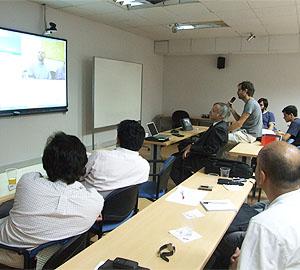
“Nowadays people develop software in an 'Open Source' mode, i.e., in anopen collaborative way making it then available in the network. Thus, largecommunities of developers have been created in the network transforming thiseffort into a great collective endevour. This has changed the paradigm ofsoftware development and Buglabs is aggressively adopting such schemes in thedevelopment of hardware as well”, says Eduardo Vera, Manager forInnovation at the Center for Mathematical Modeling (CMM), who planned thisremote tutorial.
Buglabs provides diverse modules, inter-operable components, to buildsophisticated equipment. Using appropriate programming, mostly Java, and the‘Open Source’ framework, companies may obtain novel solutions in terms ofhardware at very low cost (cost-effective prototypes).
“Maybe this solution is not the most elegant, it's like creating a Legocar; it is not the best design, but it is very cheap. These 'new solutions' canbe used by companies as prototypes to test new markets and see how the demandreacts without incurring the huge costs of today”, says Vera.
For CMM’s Manager for Innovation, companies such as Buglabs are real drivers oftechnology innovation. “Sometimes companies bet with products that are amasterpiece technically, but commercially they are an absolute failure; withlower developing costs testing something is much more attractive,” hestresses.
A partnership for innovation
Buglabs is an American company that has 18 development engineers andresearchers in its two locations:
About this initiative, Eduardo Vera explains that the main goal of this firstapproach was for both groups to get to know each other. “They showed ussome of the modules to see how they work, to better understand theircapabilities and to know what can be done with them. As we found out with thisworkshop, we were able to give our feedback to them allowing us to qualify asvalid developers of possible new applications”
Beyond the implications of the workshop, the Manager of CMM is thinking about apossible partnership or alliance between the Center and Buglabs. “Today,technological innovation is choreography of many efforts and I think it' iscrucial to explore how to integrate ourselves into promising niches. In fact,you cannot think about mathematical modeling as an isolated field. It needs tobe fully integrated with external expertise”, concludes Vera.
Related links:
www.bugblogger.com
www.bugcommunity.com
