
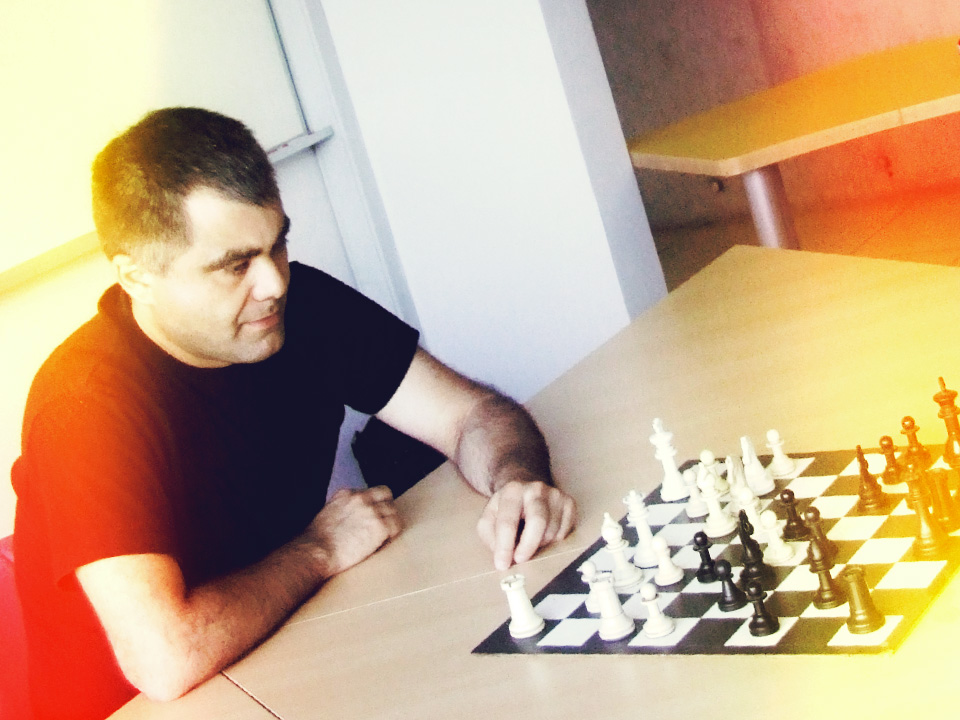
“My father used to be a high-school teacher and I used to play chess with some his high school students since I was 6 years old. One day one of them suggested to my father to enroll me in a chess club. Not much later, I could already play better than my dad and I had no interest in playing any longer with my friends, as I had reached a much better level than them”, explained Aris Daniilidis, researcher at the Center for Mathematical Modeling (CMM) of Universidad de Chile and player awarded as FIDE master (title given by the World Chess Federation). Nowadays, in spite of being already retired from competitions, he keeps devoting time to move the 16 pieces along the 64 squares of the board. So, last November 2014 he won the prize for best academic at the chess tournament of the Faculty of Physical and Mathematical Sciences (FCFM).

At 16, he was already a member of the Greek Junior Selection, which involved daily training during no less than 3 hours. After having taken a year off to prepare the national competition for admission at the university, he rejoined the team and a month and a half later he became Greek Junior Champion (August 1988). “Beside the lack of practice, and only with a month of intensive preparation, at that time I was in an optimal mood: nothing to worry about, no particular concerns”, said the professor from the Department of Mathematical Engineering (DIM) at the Universidad de Chile. He had just finished school and got admitted at the University of Athens with excellent marks and a scholarship (second in the admission order). “For a professional chess player, an intense training is crucial. After a long match, the body gets tired and the nerves are tense. A good physical condition and a psychological balance are required”, pointed out Aris.

The same year, 1988, and with the help of Efim Geller, a former number 4 world-class grandmaster and official trainer of the Greek selection at that stage, he participated at the European Junior Champion (December 1988) and a month before at the Team Chess Olympiad. There, one of his rivals was Kasparov’s former second, Grand Master András Adorján, member of the very strong Hungarian team and author of the cult classic Black is ok, which shakes the assumption that white figures begin with game with some advantages.
At that event, Aris also met Gary Kasparov in person, who at the age of 22 became the youngest ever World Chess Champion. “His playing style is always very aggressive, reminding his predecessor and former World Champion, Misha Tal, who went down in history as an extremely aggressive player. But Kasparov also looks aggressive, almost like a killer. I do not know how easily one can play against any of them”, remarked Aris. Indeed, it is commonly accepted that personality is somehow reflected in the board. In Daniilidis case, his playing style is oriented towards small positional advantages that progressively lead to a fully dominating position, rather than a straightforward attack.
About hobbies and other commitments
Aris Daniilidis’s last official chess tournament goes back to 1991. At that period, he slowed down his training and professional competitions, and concentrated on his university studies and eventually a PhD in Applied Mathematics (1997). A year later, from Greece he moved to France as a postdoc researcher, where he joined the club Échiquier Toulousain, but only played occasionally in team competitions. Afterwards, he settled down in Barcelona, what did not prevent him from travelling seldom to Toulouse in order to play with the team.
“I like chess because winning is not a matter of luck”, stressed Aris. In fact, it involves indispensable abilities such as concentration, analytic and synthetic thought, as well as abstraction. Good memory is specially required for playing chess in blind, modality wherein the eyes are covered so that the players cannot see or touch the pieces. It forces to maintain a continuous mental exercise, abstraction and blind follow-up of the calculations and the evolution of the position. It was in the French city of Pau in 1999 where Daniilidis dared to give a blind-chess exhibition with bandaged eyes and oral announcement of the moves that were projected in a screened for the audience. But he confessed that he was not able to play in blind simultaneously, which includes keeping track, stock and recover several positions progressing at the same time.
However, duties called in life and he had to stop playing official games. “Now because of my work I only have time to go once a month, on Fridays, to the Chilean Club Chess at Serrano Street, in the downtown. I do it just for fun. I wouldn’t like to participate in an official competition without any training”, highlighted Daniilidis. Actually, in Santiago he plays blitz games, a type of fast chess that is less exhausting, as the maximum duration is rarely more than 10 minutes per game.
It has been more than 15 years ago since the last time Aris played professionally. Nevertheless, he has never given up to feed his passions. Indeed, he often practices other activities like bridge, spiny or squash. Thus, some would qualify him as a representative of the humanist science tradition, showing skills in different areas.
To see the matches of Aris Daniilidis against two Grandmasters:
